On this page
A giant dog does not age the way a smaller dog does, and I would rather you plan for that difference than try to walk through it.
My disputed premise is this: for a senior giant, consistency protects mobility more than duration ever will. Three calm ten-minute outings will do more for hips, elbows, and feet over a month than one long Saturday walk, because load accumulates fast when a dog weighs as much as an adult human. You are not trying to build endurance now. You are trying to preserve range of motion, muscle, footing confidence, and a healthy weight.
I saw that tradeoff clearly with an eight-year-old mastiff-type dog who had started hesitating at the curb and needing two tries to stand on kitchen tile. He weighed 148 pounds at that visit, and his owner worried he was becoming lazy. He was not lazy. His hind-end muscle had thinned, his nails were long, and his whole day had collapsed into one late walk followed by long hours on a slick floor. We split movement into three short leash walks, added rugs through the hallway, trimmed nails, and shifted dinner slightly to stop slow weight gain. Within three weeks his rising time looked easier and his evening restlessness eased, though his stiff mornings did not disappear.
That pattern is common in very large seniors. Cartilage, joint capsule, tendon, and muscle all lose some tolerance for peak force, while body mass keeps the force high. Extra pounds then matter more than owners expect. Shorter, more frequent loading keeps synovial movement and muscle tone without the long recovery that follows overexertion.
Why giants feel age earlier in the joints
Size changes the math. A 130-pound dog loads each elbow and hip with far more force on a turn, a stair, or a slip than a 30-pound dog does, and giant breeds often develop age-related stiffness while they still look powerful. Watch for slower rising, a narrower hind stance, scuffed nails, lagging on hills, heavy panting that outlasts the walk, or lying down mid-route.
You want to catch the too-much signals early. A good outing ends with the dog still willing to walk, not exhausted into rest. If your dog needs more than an hour to settle, skips the next walk, limps that evening, or is markedly stiffer the next morning, that session was too long, too hilly, or too fast.
A short single-sentence rule helps here.
Keep the dog moving just below the point where soreness shows up the next day.
The failed weekend that teaches dosing
The mistake I see most is the make-up hike, and it comes from a kind place. An owner works all week, feels guilty, then tries to give a senior Great Dane-type dog a big Saturday to compensate.
One family I advised had fallen into that rhythm with a ten-year-old, large-boned dog who spent weekdays on the couch and weekends on a 2-mile rail-trail loop with a long downhill at the end. He would finish bright-eyed, then spend that night shifting, licking a front carpus, and refusing the last three porch steps. Monday looked worse than Friday, so they rested him all week, which made the next Saturday harder. We replaced the loop with two 12-minute neighborhood walks on Saturday and one gentle 15-minute sniff walk Sunday, all on leash with turns kept wide. His post-walk panting shortened from nearly an hour to about 20 minutes, but the downhill soreness pattern still flared whenever they added slopes back too quickly.
That cycle is why I weigh exercise like food therapy. Dose matters more than intention.
Build the week around short, repeatable movement
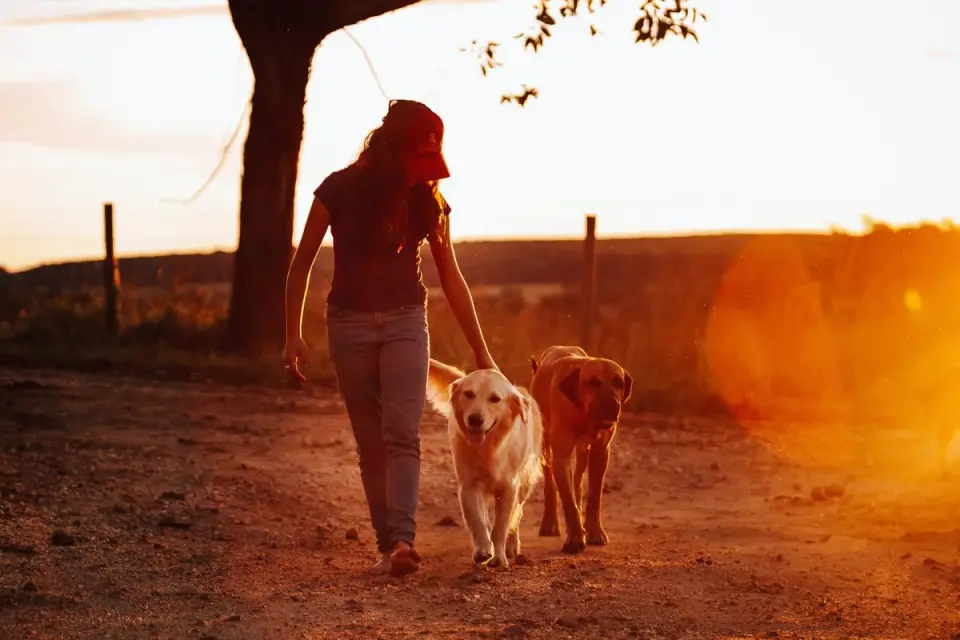
Aim for two to three brief walks daily, roughly 10 to 20 minutes each depending on fitness, heat, and footing. Keep the pace conversational, let the dog sniff, and keep hills, stairs, fetch, wrestling, and slick sprint turns out of the base plan. Flat grass, dirt paths, and dry pavement with traction are your best surfaces.
Add strength without impact twice weekly. Try three to five slow sit-to-stands on carpet, short weight shifts while standing, stepping over one low broomstick pole, and a few minutes of controlled walking through shallow, calm water only where swimming skill and supervision allow. If you are choosing between water and pavement, this comparison of swimming vs walking for an arthritic dog can help you match the option to the dog in front of you.
Home setup matters as much as the walk for giants, because one slip getting up can cost a week. Put runners on slick halls, add a mat at every rising spot, use a ramp for the car, raise food and water so the neck and shoulders stay neutral, and keep nails short so toes can grip. Owners of very large seniors often need different traction and bedding choices than small-dog households, which is why I point them to guidance on how home needs differ for small versus large senior dogs.
Heat discipline is non-negotiable. Walk early or late, bring water, watch the tongue and gait, and cut the outing short at the first sign of dragging, wide panting, or seeking shade. Giant seniors overheat faster and cool slower.
Where joint nutrition realistically fits
Movement, weight, and footing do the heavy lifting. Nutrition and supplements may help support the joint environment around that plan, but they do not replace dosing exercise correctly.
That is where I stay ingredient-literate. Glucosamine and chondroitin are widely used in canine joint products, yet the direct evidence is narrower than marketing suggests. Laboratory work has shown glucosamine can “prevent experimentally induced cartilage degradation in vitro,” as summarized in the Journal of Veterinary Medical Science, which is useful biology but not proof that every chew restores mobility in an old Dane. Chondroitin is sometimes described in joint-health literature as an ingredient that “supports healthy synovial fluid homeostasis,” a framing discussed in Frontiers in Veterinary Science, which speaks to joint environment rather than pain relief.
I weigh what a supplement can realistically do for diet, mobility, and recovery this way: choose products with transparent glucosamine, chondroitin, omega-3, and green-lipped mussel levels, feed a complete diet that keeps ribs easily felt, ask your veterinarian about dose and interactions, and judge the product by steadier rising, willingness to walk, and next-day comfort over four to six weeks — not by one good afternoon.
A skeptical friend would ask whether that is just expensive hope. My answer is plain: hope would be promising a cure. A bounded trial alongside correct exercise, weight control, and pain assessment is reasonable care, and stopping a product that changes nothing is also good medicine.
When the usual plan has to bend
Not every senior giant can do the standard two-to-three-walk template, and heat, pain flares, and recovery weeks force changes. I worked with an owner of an 11-year-old giant-breed mix during a hot August when even mornings stayed humid and the dog began planting his feet at the driveway. Pushing through would have soured him on walks entirely. We paused road walks for 10 nights and switched to four 5-minute garden strolls plus indoor mat work, cool-water paw rinses, nose games, and extra grooming contact for circulation and mood. On day 11, with cooler air, he offered a full block again without the long lie-down afterward, though stairs still required a sling assist and a slower pace.
Bend the plan, do not abandon movement. During flares, shorten rather than stop, keep joints moving gently, track appetite, water, sleep, and limb use, and call your veterinarian promptly for new lameness, swelling, crying out, back-leg knuckling, incontinence changes, or exercise intolerance that worsens.
Your owner checklist for the next two weeks
- Split exercise into brief daily walks, not one long outing.
- Keep surfaces flat with traction; avoid sprinting, jumping, and slick floors.
- Add two short strength sessions and nail, weight, and bedding checks.
- Log rising ease, walk willingness, panting recovery, and next-morning stiffness.
- Use any joint supplement as a timed trial with your veterinarian, judged against that log.
- Recheck promptly if lameness, swelling, or fatigue persists beyond a day.
You are not trying to keep a senior giant young. You are keeping an old, heavy, loyal body comfortable in motion, one manageable day at a time.
Sources
- Protective effects of turmerosaccharides rich extract of Curcuma longa L. in osteoarthritic dogs — Frontiers in Veterinary Science
- A review of the clinical efficacy and adverse effects of disease modifying osteoarthritic drugs (DMOADs) in dogs with special focus on glucosamine and pentosan polysulfate; do they work? — Journal of Veterinary Medical Science