On this page
Stiff hips do better with short, low-impact movement that builds muscle without pounding joints. My disputed premise is this: most owners rest a stiff dog too much, and the hips get stiffer because the supporting muscle fades.
You will not stretch a hip joint back to puppy looseness. You can keep the muscles around it — glutes, hamstrings, core and shoulders — strong enough that getting up, walking and squatting to toilet cost less effort. That is the whole job of low impact exercises for dogs with stiff hips.
In practice, vets often see the same pattern in a senior large breed. Clinton in Henderson, Nevada, noticed his 10-year-old neutered male Catahoula Leopard Dog, Chimmy, taking three slow tries to rise from the kitchen tile each morning, then walking it off within 60 yards. The choice was not longer hikes or full rest, but five-minute supported sessions twice a day plus better traction.
Stiffness is a movement problem first
A hip that is arthritic or poorly conformed hurts on hard loading, slipping and sudden twisting. Pain then shortens stride, and shorter strides weaken the hind end over weeks. VCA Hospitals notes that controlled activity and weight control are central to managing arthritis in dogs, alongside veterinary care.
That matches rehab thinking. Muscle is joint support you can rebuild. Food therapy, body weight and joint nutrition matter, but they cannot replace contractions.
Keep one rule.
The routine that protects hips without pounding them
Aim for short and frequent. Two to three 5- to 10-minute sessions beat one 30-minute march for most stiff dogs. Stop if you see toe dragging, repeated sitting, panting that does not settle in five minutes, or lameness worse the next morning.
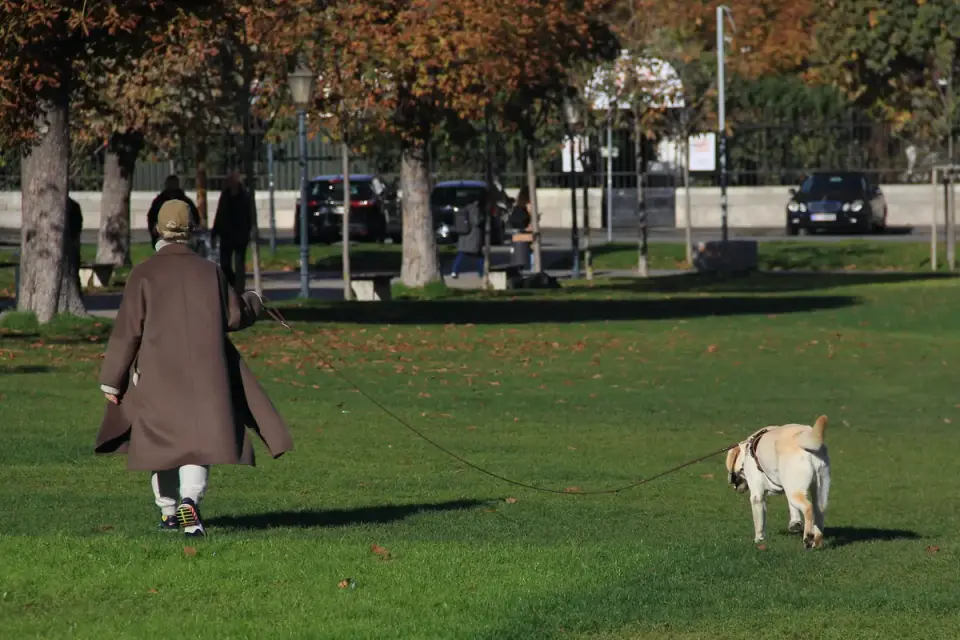
- Warm-up sniff walk, 3 to 5 minutes. Flat, grippy ground on leash. Let the dog set pace. This raises tissue temperature before any strength work. For ideas on surface and pace, compare Swimming vs Walking for an Arthritic Dog: Which Actually Helps More?
- Weight shifts, 5 reps per side. With your dog standing square on a rug, gently rock the hips an inch side to side with a hand on each side, or lure the head slowly left and right so weight transfers through the hind legs.
- Sit-to-stand, 3 to 5 reps. On carpet, ask for a tucked sit, then stand, then walk two steps and repeat. Skip it if elbows splay or the dog bunny-hops up every time.
- Curb step-ups, 4 reps per side. One low 4-inch curb or stable step. Front feet up, pause, hind feet up, pause, then walk off. Curbs are useful gym equipment when used this way, as in Dog Treadmill vs Outdoor Walking: Which One Actually Serves an Achy Dog Better?
- Cookie-stretch side bends, 3 per side. Lure nose toward hip, then toward shoulder, holding two seconds. This supports spinal and core flexibility that unloads hips.
- Slow figure-8s, 2 minutes. Wide loops around two cones or chairs 10 feet apart. It encourages hind-leg stepping without sharp turns.
- Cool-down and traction check, 2 minutes. Easy walk, then rest on a nonslip bed.
Swimming and underwater treadmill can fit here for dogs that fatigue fast on land, because buoyancy reduces load while allowing motion. Land walking still teaches balance and bone loading, so most dogs do best with a mix guided by their veterinarian.
Make weight and the house do half the work
Extra body fat increases load on every step and can sustain low-grade inflammation from adipose tissue. Nutritionists weigh diet change as one of the highest-leverage tools for mobility, often more powerful than any single supplement. Cornell University College of Veterinary Medicine emphasizes keeping arthritic dogs lean and active with low-impact exercise.
You can act on that this week. Measure food, score body condition with your clinic, and aim for a visible waist and felt ribs under light cover. Add rugs or yoga-mat runners on slick halls, a ramp for the car, raised food and water bowls if neck or back flexing looks hard, and a firm orthopedic bed that lets Chimmy rise without sinking.
Off-leash sprinting, fetch with hard stops, and stairs as exercise often flare stiff hips. Controlled on-leash work protects the joint while you rebuild fitness, a trade-off explained in Off-Leash Play vs On-Leash Walks for Exercise: What Actually Serves a Dog’s Joints
Where food and joint support fit beside movement
Think of supplements the way a nutritionist does: they may help support normal joint structure and day-to-day comfort, but they do not build muscle or replace weight loss. Glucosamine and chondroitin are among the most studied joint support ingredients for dogs, and green-lipped mussel contains omega-3 fatty acids and glycosaminoglycans that have been studied for joint support.
Weigh what a supplement can realistically do for diet, mobility, and recovery. For a dog eating a complete adult or senior diet, an omega-3 topper from marine sources may help support a healthy inflammatory response as part of whole-patient care. A joint chew may help support flexibility alongside movement. Neither lets you skip the walks, the weight plan or pain assessment.
Ask your veterinarian whether prescription joint diets, EPA/DHA dosing for your dog’s weight, or pain medication are needed before you add products. Cold mornings often make stiffness look worse, and warmth, massage and a shorter first outing help; see Does Cold Weather Make a Senior Dog Seem Stiffer and Slower Than Usual?
Your 2-week owner checklist
Copy this to the fridge.
- Walk 5 to 10 minutes, twice daily, flat and grippy. Log distance and morning rise time.
- Do sit-to-stands and step-ups every other day. Add one rep per move if next-day stiffness is unchanged.
- Lay traction, add a ramp, and block slippery stairs for two weeks.
- Weigh food, weigh the dog weekly, and share the trend with your clinic.
- Call your veterinarian promptly for crying out, new hind-leg knuckling, swelling, loss of appetite, or lameness lasting more than 48 hours.
Small steady loading wins.
Frequently asked questions
How long should I walk a dog with stiff hips?
Start with 5 to 10 minutes twice daily on flat, nonslip ground. Add 2 to 3 minutes per walk only if morning stiffness is stable and your dog recovers within minutes.
Are stairs bad for dogs with stiff hips?
Repeated stairs as exercise often flare soreness. Use a ramp or lift support for daily access and save one low step for 3 to 4 controlled step-ups every other day if your vet approves.
Should I rest my dog completely on stiff days?
Avoid hard runs and long hikes, but keep gentle potty walks and weight shifts. Complete rest for days tends to increase stiffness; call your vet if lameness lasts over 48 hours.
Sources
- Arthritis in Dogs — VCA Hospitals